

Hazel reads your full Recharge history (subscriptions, charges, customers, cancellation reasons, bundles, status history) and answers business questions in plain English. No dashboards to build.
May 23, 2026
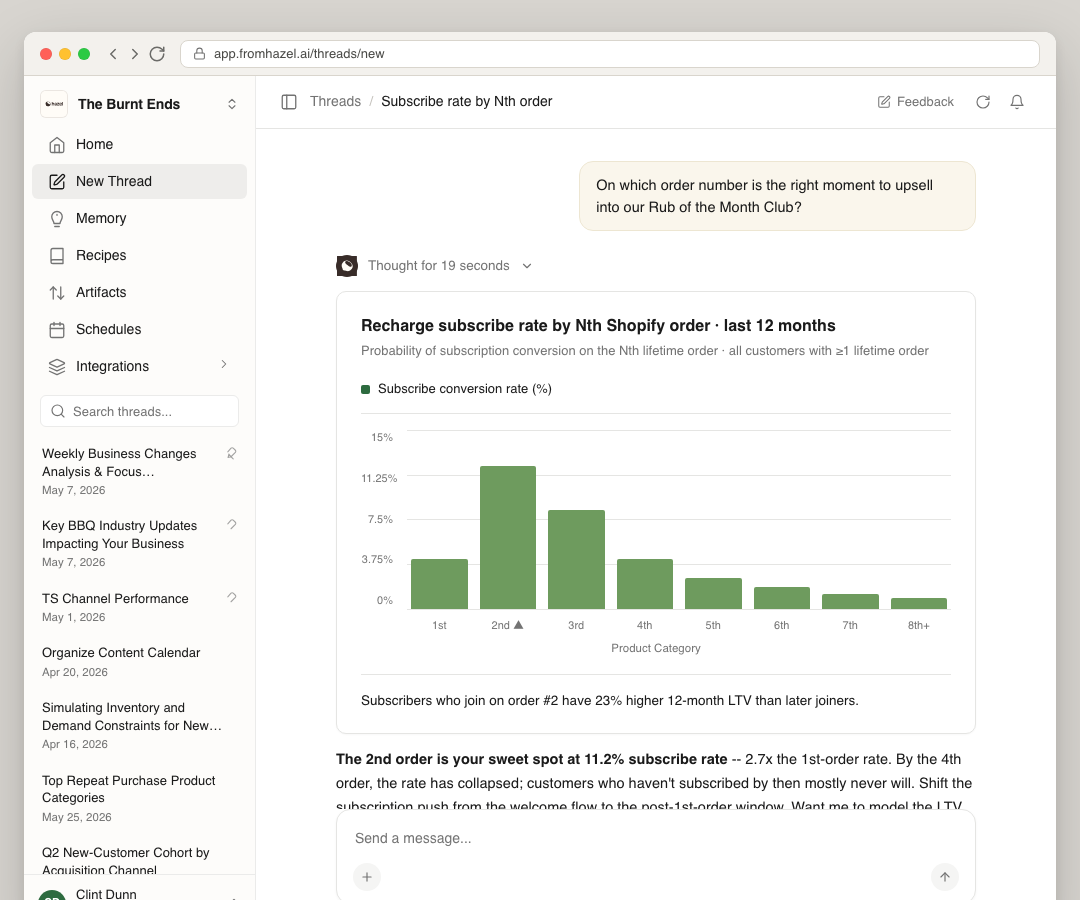
Hazel is an AI coworker that connects to your Recharge account and answers business questions about your subscription business the way an analyst would. Once connected, Hazel ingests every subscription with its status, cadence, pricing, and lifecycle events, plus charges, customers, cancellation reasons, bundles, and full status history, then refreshes every few hours. Ask Hazel about churn by cohort, the lift from a cancellation flow change, MRR trends, frequency-change behavior before first recurring order, or which refill number is the right moment to upsell, and you get an answer with the numbers behind it. Hazel keeps the full historical record of how each subscription has changed over time, so you can reconstruct what actually happened, not just where things landed. For consumer brands running on Recharge, Hazel replaces the work of exporting queued charges and pivoting them in spreadsheets, and it pairs Recharge data with Shopify, Klaviyo, GA4, and your ad platforms so cross-source questions are a single prompt.
Hazel reads the Recharge data that matters for analyzing a subscription business and lets you query it conversationally:
Hazel keeps the full historical record going back to your first subscription, so cohort analyses, refill-curve math, and retention-by-month questions are one prompt.
These are real questions Hazel customers ask about their Recharge data:
"Why is recurring subscription revenue from the recharge sales channel down month over month. Are churning subscribers placing one-time online store orders instead?"
"On which purchase (1st, 2nd, 3rd) is the right moment to upsell a customer into our Recharge subscription program?"
"How many people change their frequency in Recharge before their first recurring order?"
"What are the biggest unlocks from Recharge subscription data that will meaningfully improve LTV?"
"Compare churn rates for subscribers who got a lifetime discount after contacting CS vs. subscribers who got the discount AND a frequency adjustment."
"Of customers who received this Klaviyo flow last month, how many created or reactivated a Recharge subscription afterward?"
"Pull queued Recharge orders for the next 28 days and predict our chargeback rate for the next 7."
"Show contact rate by customer (tagged contacted_cs in Shopify) cross-referenced with refill number in Recharge, by month."
Recharge AI Reports generates plain-English summaries inside the Recharge admin. Conversational Analytics lets you ask questions and take action in one place. Both are useful for quick in-platform checks. Hazel is the analyst layer above: it ingests your full Recharge history, joins it with Shopify, Klaviyo, ad platforms, and reviews, and answers cross-source questions that the in-admin tools can't reach. "Of customers who received this Klaviyo flow last month, how many created or reactivated a Recharge subscription afterward?" is one prompt in Hazel, not possible in Recharge's admin.
Yes. Hazel reads both Recharge and Skio data. If you're migrating from Skio to Recharge (or evaluating the combined platform), Hazel bridges historical Skio data with new Recharge data so your retention curves and cohort analyses survive the transition. See also: Hazel for Skio.
Yes. Connect Recharge from the Hazel marketplace by pasting your Recharge API token. Setup takes under a minute.
Peel and Glew are subscription analytics dashboards. You pick metrics from a menu. Hazel is analyst-first: you ask any question in plain English and Hazel writes the analysis. There's no dashboard to learn and no metric to pre-define. You also get the same agent across Shopify, ad platforms, email, reviews, and the rest of your stack, not just subscriptions.
No. Recharge's Concierge SMS and Support Agents handle subscriber requests over text. Skips, swaps, address changes. Hazel is the analytics layer. It reads your data (including outputs from Recharge's AI features) and answers business questions. Different surface entirely.
Roughly every 6 hours.
No. Hazel only reads. We never cancel, pause, swap, or modify any subscription, charge, or customer in Recharge.
Yes. This is one of the most common use cases. Hazel ties Recharge subscribers back to Shopify customers and orders, so you can isolate subscription revenue vs. one-time revenue, see whether churning subscribers are switching to one-time online store orders, and run cohort analyses that span both sources.
Yes. Bundle subscriptions are monitored separately from single-item subscriptions so unit counts and revenue stay accurate when subscribers swap components. You can analyze the bundle as a unit or drill into the component SKUs.
Yes. Hazel keeps the full chronological status history for every subscription going back to your first subscription, so you can answer "what changed in the 30 days before this cohort cancelled" without losing data to the in-app timeline limit.
Yes. Hazel reads your queued charges with SKUs and quantities, so you can forecast upcoming revenue, predict chargeback rates over the next 7-28 days, and reconcile against what Recharge says is upcoming.
Hazel isn't a subscription platform. It's the AI coworker on top of whichever platform you run. If you're comparing Recharge and Stay AI, Hazel reads both so you can evaluate retention curves side by side.
Book a call and we'll walk through your Recharge data, the questions you want to answer, and what the rollout looks like.

Hazel helps your team uncover new revenue, catch problems early, and make smarter, faster decisions before you even know what to ask.