

Hazel reads your full Shopify history (orders, customers, products, fulfillments, refunds, tags, metafields) and answers business questions in plain English. No dashboards to build.
May 23, 2026
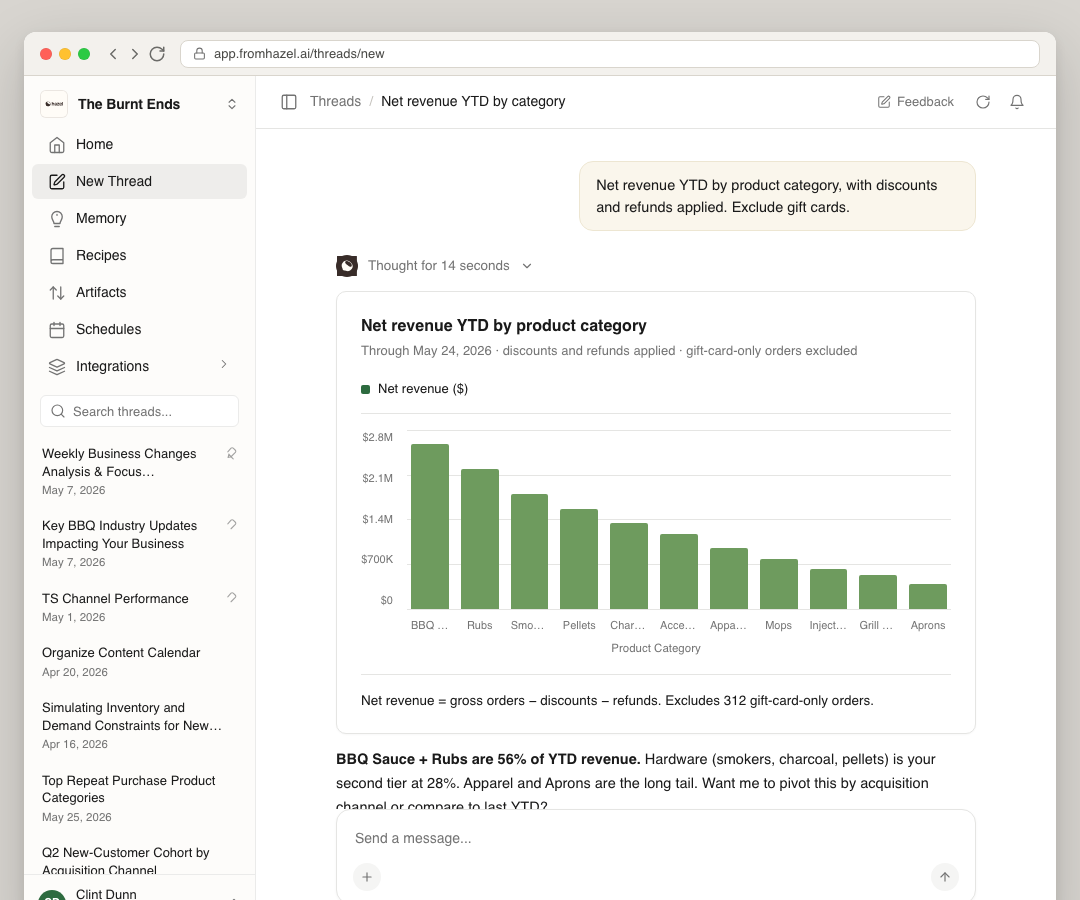
Hazel is an AI coworker that connects to your Shopify store and answers business questions about your data the way an analyst would. Once installed, Hazel ingests your full order history, customers, products and variants, fulfillments, refunds, discounts, and metafields, then refreshes every few hours. Ask Hazel about repeat purchase rates, the lift from a tagged campaign, AOV trends, or how a launch performed in its first 30 days, and you get an answer with the numbers behind it. Hazel deduplicates customers across guest and registered checkouts so your customer counts reflect real people, not Shopify rows. For consumer brands running on Shopify, Hazel replaces the work of opening Reports, exporting CSVs, and stitching data together by hand, and it pairs Shopify data with your ad platforms, email, subscriptions, and reviews so cross-source questions are a single prompt.
Hazel reads the Shopify data that matters for analyzing a consumer brand and lets you query it conversationally:
Hazel keeps the full historical record, so cohort analyses going back to your first sale are one prompt.
These are real questions Hazel customers ask about their Shopify data:
"Can you summarize our YTD conversion funnel on Shopify by month. Unique visits, ATC, checkout, CVR?"
"Compare net revenue from orders tagged 'CDAA25' to orders tagged 'CDAA26'."
"Put together a cohort analysis of Shopify customers since May 2025, and a separate one for Amazon since November 2025."
"What were the most successful drops in their first 30 days, using first sale date as launch date?"
"How does paid spend on Meta tagged 'hair' correlate with new customer acquisition on hair from Shopify by week?"
"How many shipments in the past 12 months were first-time orders vs. recurring subscription orders?"
"Give me a robust definition of net revenue that includes discounts and shipping revenue, then apply it by product role."
"Show new customer order volume by product for body, hair, eye, and face by week YTD. Core products only, exclude refills."
Yes. Install Hazel from the Shopify App Store. Approval takes one click from your Shopify admin.
Sidekick (including Sidekick Pulse, Shopify's proactive Winter '26 AI coworker) and Shopify Magic live inside the Shopify admin and work on Shopify-native data. Hazel works *across* Shopify and the rest of your stack. The same agent answers cross-source questions (ad spend vs. revenue, subscription LTV, email-attributed reorders) that Sidekick can't reach because it only sees Shopify.
Triple Whale, Polar, and Northbeam are ad-attribution-first dashboards. They start with paid media and work outward. Glew is closer to Hazel positioning-wise: an analytics-first tool for ecommerce. The difference is that Hazel is conversational and cross-source by default. You don't learn a dashboard or define metrics in advance: you ask a question spanning Shopify, ads, email, subscriptions, or reviews and Hazel works it the way an analyst would.
Roughly every 6 hours.
No. Hazel only reads. We never write to your orders, customers, or products.
Hazel deduplicates customers across guest and registered checkouts using identity resolution, so one real person who checks out as a guest and then later creates an account is one customer in Hazel. Shopify counts them as two. Hazel's count is closer to your true customer base.
Yes. Install Hazel separately on each storefront. You can run analyses scoped to one store or across all of them.
Yes. Order tags, customer tags, product tags, and metafields are all queryable. You can pivot any analysis by your existing tagging conventions without writing SQL.
Hazel connects via Shopify's OAuth with read-only scopes. We never write to your store. Your data is encrypted in transit and at rest, and Hazel does not share your data with other customers or use it for model training.
No. Hazel is an internal analytics tool for your team. It answers business questions for operators, not shoppers.
Book a call and we'll walk through your data, the questions you want to answer, and what the rollout looks like.

Hazel helps your team uncover new revenue, catch problems early, and make smarter, faster decisions before you even know what to ask.