

Hazel reads your full Search Console history (queries, pages, clicks, impressions, CTR, average position) and answers SEO and brand-search questions in plain English. No dashboards to build.
May 23, 2026
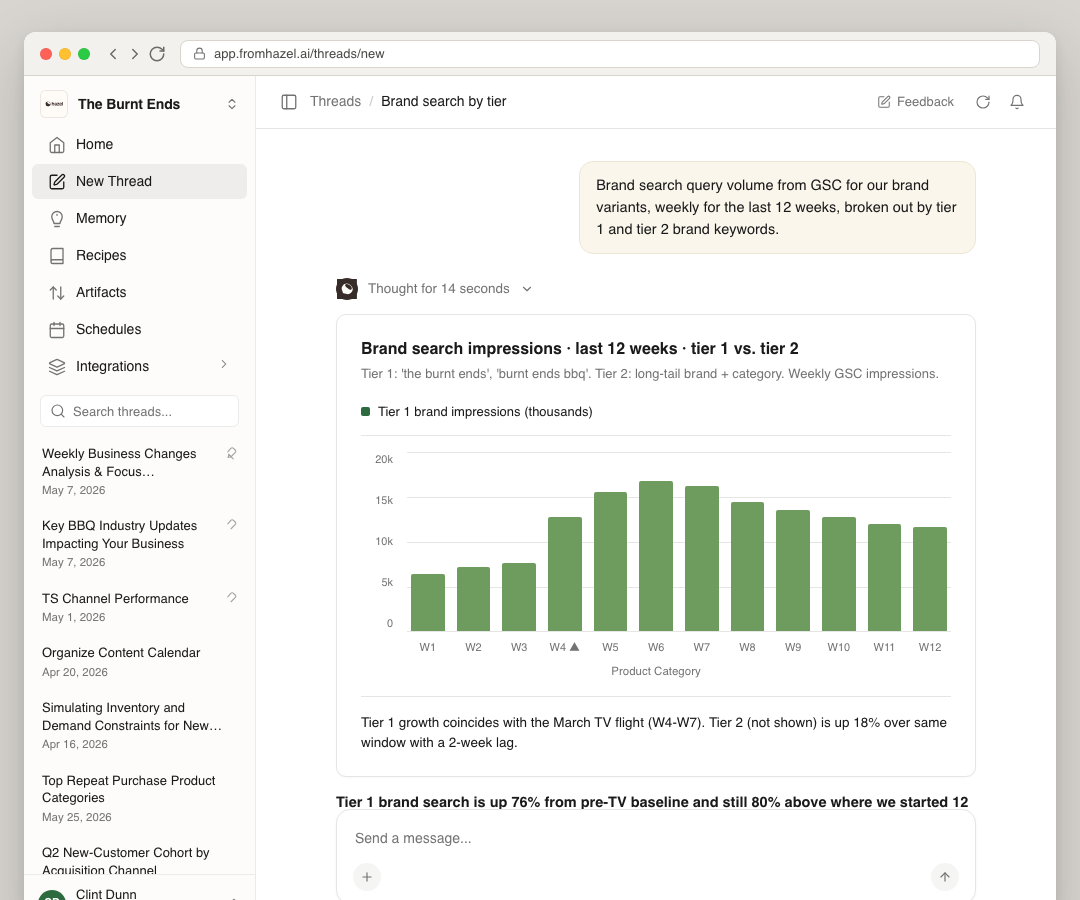
Hazel is an AI coworker that connects to Google Search Console and answers business questions about your organic search performance the way an analyst would. Once connected, Hazel ingests your full keyword performance (queries, impressions, clicks, CTR, average position), page-level traffic distribution, site-wide visibility trends, and sitemap and indexing health, then refreshes every few hours. Ask Hazel about brand-search query volume, pages with high impressions but underperforming CTR, organic traffic shifts after a SERP change, or how a TV flight moved branded search, and you get an answer with the numbers behind it. Hazel pairs Google Search Console with the rest of your stack (Google Analytics, Google Ads, Meta, Shopify, Klaviyo) so questions like "did organic search revenue actually fall when our CTR dropped?" or "how did TV spend correlate with branded impressions and new customers?" are a single prompt instead of a multi-tool stitch job.
Hazel reads the Google Search Console data that matters for analyzing a consumer brand and lets you query it conversationally:
Hazel keeps the full historical record Search Console exposes, so 6-, 12-, and 24-month brand search trend analyses are one prompt.
Common questions consumer brands ask about their Google Search Console data:
"Pull brand search query volume from Search Console for our brand name variants over the last 6 months, weekly, broken out by tier 1 and tier 2 brand keywords."
"We saw a traffic spike from Google yesterday: which queries drove it, and how does that compare to our last 30-day median?"
"Pull TV spend by week alongside tier 1 brand impressions from Search Console and daily new customers from Shopify. I want to test whether brand pushes are landing in branded search."
"Are brand search queries recovering vs. last quarter? Just Search Console organic, not paid."
"Which non-brand queries are we ranking for in positions 4-10 with high impressions but low CTR? Those are quick-win pages to optimize."
"Pages with falling CTR over the last 90 days: pull each page's average position and title, and flag any that lost a featured snippet or rich result."
"Top 20 query intent classifications for our organic traffic this month: informational, transactional, navigational. How does each cluster's CVR look in GA4?"
"Pull Search Console query data for all pages tagged 'blog' and join to GA4 to show which blog posts actually convert vs. which only attract traffic."
"Is there a problem with our SERP / SEO? Anything in Search Console that explains the traffic dip this week?"
"Show me all queries where we dropped from page 1 to page 2 in the last 30 days. What's the total impression and click loss?"
Yes. Add it from the Hazel marketplace and authenticate with a Google account that has access to your Search Console property. OAuth, one-click, no API keys.
Google's new AI-powered configuration in the Performance report is the most asked-about new GSC feature in 2026. It's a natural-language filter helper. You describe the slice you want and it sets the dropdowns. It's useful, but it's bounded by the Search Console UI and only sees Search Console data. Hazel ingests the full Search Console dataset into an analytical store, keeps the full historical window queryable, and joins it with your other sources so you can ask cross-source questions Search Console alone can't answer: like correlating brand impressions with TV spend, paid brand CVR, or new-customer revenue from Shopify. Google's AI-powered configuration writes filters for you. Hazel writes the analysis: joining GSC to GA4 sessions, Google Ads spend, and Shopify orders so brand-search work has actual revenue attached.
A GSC MCP server gives an LLM raw API access. You still have to host it, manage OAuth, write the prompts that turn API responses into analysis, and accept that the agent only sees Search Console. Hazel is the managed analytics layer: data is already ingested, historical, joined to your other sources, and ready for conversational analysis from the first prompt.
Dashboards force you to define the question in advance. Hazel works the way an analyst would, starting from your question. "are brand queries recovering?", "which pages have high impressions but bad CTR?", "did the SERP change move revenue?", and assembles the analysis on the fly, with the numbers and the chart.
Roughly every 6 hours. Keep in mind Google itself applies a 2-3 day reporting lag to Search Console data, which affects every tool that reads the GSC API.
No. Hazel only reads. We don't submit sitemaps, request indexing, or change any settings.
That's a Google privacy protection applied at the source. It affects every Search Console consumer. Hazel included. Aggregate trends and branded-search analysis are still reliable; tail-keyword discovery is the place you'll feel the gap.
Yes. Google now folds AI Overviews and AI Mode data into the standard Performance report under the "Web" search type, so as that data lands in your Search Console property Hazel reads it like any other GSC metric.
Yes. This is the main reason customers connect GSC to Hazel. Brand-search lift studies, TV-to-organic correlation, and "did organic revenue actually move?" questions all require joining Search Console with at least one of GA4, Google Ads, and your store.
Several. Google's own AI-powered configuration helps set filters inside the Performance report. Open-source MCP servers (mcp-gsc, mcp-server-gsc) let you wire Claude or another LLM to the GSC API locally. SEO platforms like Ahrefs and Semrush consume GSC data for ranking analysis. Hazel is different: it pre-ingests your GSC data and joins it with GA4, Google Ads, Shopify, and your other sources so you can answer revenue-level questions, not just SEO questions.
Not natively. You'd need to connect it via an MCP server or custom integration. Hazel connects to your Search Console property via OAuth and keeps your data ingested and ready for cross-source analysis from the first prompt.
Google folds AI Overviews and AI Mode impressions into the standard Performance report under the "Web" search type (live as of May 2026). Hazel ingests this data automatically. Ask about AI Overview traffic the same way you'd ask about any other GSC metric.
Book a call and we'll walk through your data, the questions you want to answer, and what the rollout looks like.

Hazel helps your team uncover new revenue, catch problems early, and make smarter, faster decisions before you even know what to ask.